Skip to content
Menu

Hyphenated Stories

Exploring the little line between genres and borders

About

This is a blog about books that span genres, writers who cross borders, and never fitting in neatly. With a particular interest in authors of Asian backgrounds, I enjoy speculative fiction, historical accounts, sci-fi, fantasy, and tales of faraway places. Sometimes there are travel photos.

Copyright JZ Ting 2017

Follow

  • View hyphenatewriter’s profile on Twitter
  • View hyphenatedwriter’s profile on Instagram

Archives

  • February 2017
  • January 2017

Tag: historical account

Identities then and now: A Many-Splendoured Thing by Han Suyin

After a fortnight or so of work deadlines, extreme Sydney heat (a recurring ordeal), I finally have space to blog again. I’m already behind my one-post-a-week target as well as my reading target, so hands to keyboard, eyes to screen, time to get back on the horse!

* * *

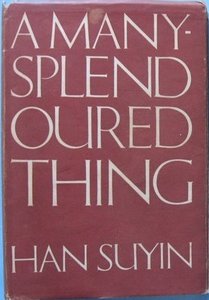
Second-hand bookstores are treasure chests; I can spend hours in them thrilled by the overwhelming choice. One of my finds last year in the Berkelouw Book Barn, was a first edition of A Many-Splendoured Thing (1952) by Han Suyin.
a_many-splendoured_thing_28book29
First edition cover. Image source: Wikipedia.

A Many-Splendoured Thing is a semi-autobiographical story of Han Suyin (birth name: Rosalie Elisabeth Kuanghu Chow), a Chinese-identifying Eurasian widow and single mother working as a doctor in late-1940s Hong Kong. There’s turmoil on the mainland as the Communists sweep south, social and racial prejudice in British-colonised Hong Kong, and eventually, the Korean War. Amidst all this uncertainty Suyin meets Mark, a married British foreign correspondent, and the two fall in love, a “many-splendoured thing” that in a period of such upheaval, is their brightest point of certainty.

The romance wasn’t the strong point. It’s there as the book’s plot, the driver and basis for some lovely emotional scenes, but the lovers’ dialogue is largely too flowery and philosophical for natural empathy. Far better are the descriptions of 1949-50s Hong Kong and all its people: the Christian missionaries who have fled China and sigh over their failures to convert more Chinese Christians; the society Englishmen and women hosting soirees in their lavish Hong Kong houses, the wealthy mainland Chinese who “relocate” to Hong Kong, the not-so-wealthy mainland Chinese who come as refugees, and the Hong Hong Chinese living their lives while their island hosts visitors both wanted and unwanted, united only in their anxiety of whether or not the Communists will invade. As a multilingual Eurasian woman and doctor, Suyin moves through all these circles sometimes smoothly, sometimes not, her observations and experiences a sharp and lyrical insight into Hong Kong at the time.

There’s so much of this book I found poignantly current. Over and over Suyin has to patiently explain to westerners the complexities of Chinese culture, that Hong Kong is different to Shanghai which is different to Peking, or that being proud of her country doesn’t make her a Communist, with a familiar growing weariness. Comments like “I’ve only been here three years. I don’t know a word of Chinese, of course. You’re the first Chinese girl I’ve talked to” could fall from the mouth of so many western expats in China, while Suyin’s furious reaction to an American man addressing her with a racist insult, which she describes as “trigger word with the Chinese, who have emotional reaction to words just as Westerners do”, comes right out of the blogosphere.

At the same time, Suyin is Chinese in a time of China’s change, and has to figure out what that identity means. She’s fiercely proud of her feudal family in Chongqing even as she knows their days in the old ways are numbered. Although the widow of a Kuomintang officer, she’s defensive of the Communists when westerners disparage them because they’re still her people. And although she spends some time in the People’s Army and leaves when she realises she can never fit in, she still seems to wish them the best in building their New China. Importantly, Suyin remains strictly apolitical, never taking a position for or against the various forces, even though her family and marital history indicate where her sympathies should naturally be. Sunyin is a doctor, she doesn’t want men to die, she simply wants to live and love in a way the world says she can’t.

Being with Mark is the closest Suyin gets to just being herself, whoever that is, but it can’t last. He offers Suyin a choice, one she notes is not hers alone, but that of many another “westernized Asian brought up between two worlds, split and two-layered.” At that line, I thought of a Beijing bar where a friend and I discussed how difficult it can feel being caught between east and west. Nearly seventy years have passed between this book and that bar. Sometimes, it still feels like the world wants us to choose.
 

By JZTin books, china, historical, romanceFebruary 10, 2017February 10, 2017720 WordsLeave a comment

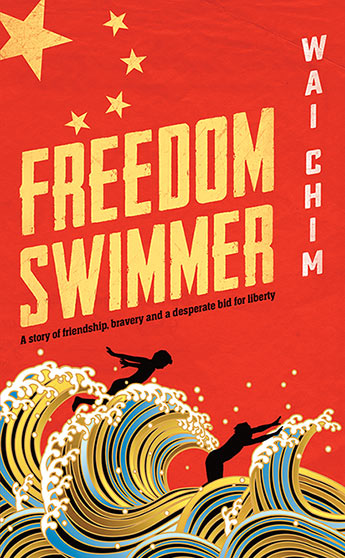
Freedom Swimmer (2016) by Wai Chim

At a Sydney book event late last year, I met an author near the drinks table. There wasn’t much air-conditioning at the venue, but there was plenty of good wine and cheese, and, it turned out, good conversation. Which is how I met Wai Chim (Twitter: onewpc) and found a new book to read.

Wai Chim’s Freedom Swimmer starts with corpses in the river, and ends on the open ocean. Based off the author’s own family history, it’s the story of Ming, a famine survivor and peasant boy, and Li, an educated city boy sent to the village as part of the Community Party worker’s program, who together eventually attempt to escape Mao’s China by undergoing the dangerous ‘freedom swim’ to Hong Kong.

There’s been plenty written about the Cultural Revolution, but not much for a younger audience. Freedom Swimmer is a YA book, and the traumas which appear in it – famine, fanatics, tested family loyalties – are tactfully written in a way that, to someone more familiar with the history, comes off as distancing the horror, but is appropriate for a young reader (Allen & Unwin puts the book in the category of 11-14 years). Ming and Li are wonderfully realised, optimistic voices into two different lives of the time – Chinese city student and Chinese village peasant – who bond over swimming and innocently worry about all the things teenage boys do: school work, being part of a group, and girls. Only this is China in the Cultural Revolution, so school work is tilling fields for points and memorising Mao quotes, and being in or out with the group can be the difference between life and death.

Girl problems in this world are, in comparison, innocent and simple. Mothers and aunts aside, there’s only one girl of note, Fei, another famine survivor who is friends with Ming, and later Li. Happily, there’s no love triangle or fight for her affections, and Li’s wholehearted support of Ming’s courtship of Fei is one of the book’s delights. There’s sweetness in Li’s enthusiasm to plan schemes for Ming to see Fei, and Fei herself, although only seen from Li and Ming’s points of view, is revealed through conversation and letters to be even more eloquent than the boys with her own dreams of freedom. At the same time, Fei’s ‘lessons’ are an opportunity to point out another dimension to Communist China: while the Party pronounced too much book learning to be “harmful”, it also created modern opportunities for women who, Mao declared, hold up half the sky.

Each of the characters has their dream of freedom – in the ocean, in poetry and music, in flights of imagination – which they harbour despite the oppression that surrounds them. Chim does a great job of illustrating the atmosphere of the era through Party officials, letters and small moments, building slow enough that, as many of the peasant characters seem to feel, the new society of Communist China is just something to live with as long as there’s food to eat, until events happen that reveal the regime’s brutality, and prompt Ming and Li to swim to Hong Kong or die trying. As a story of resilience and spirit it’s an engaging novel; as an introduction the Cultural Revolution for a younger reader, or any reader unfamiliar with the subject, it’s immediately accessible. And although to me the epilogue in China feels a bit too neat, the image of the final line both aches and uplifts in its promise of a better future.

Freedom Swimmer is published by Allen & Unwin, available here. Recommended read.

By JZTin books, china, young adultJanuary 16, 2017January 16, 2017621 WordsLeave a comment
Create a website or blog at WordPress.com

Menu

  • Home
  • About
  • Contact
  • Subscribe Subscribed
    • Hyphenated Stories
    • Already have a WordPress.com account? Log in now.
    • Hyphenated Stories
    • Subscribe Subscribed
    • Sign up
    • Log in
    • Report this content
    • View site in Reader
    • Manage subscriptions
    • Collapse this bar
 

Loading Comments...